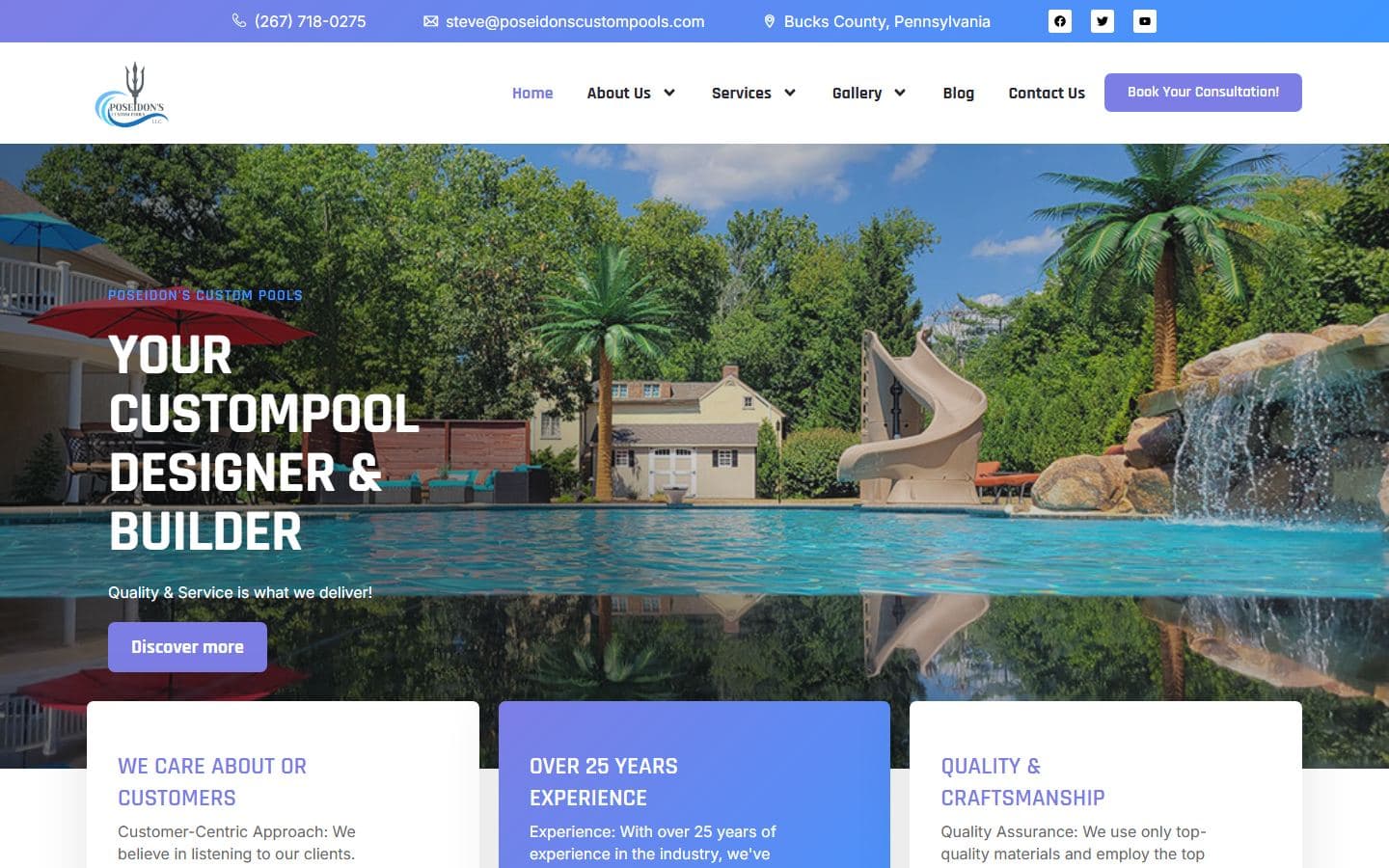
Pool buyers use search alongside referrals, project photographs, and conversations with builders. A useful local presence helps a homeowner understand whether your company serves the property and delivers the kind of pool project they are considering.
This checklist brings together practical local-search priorities. It does not claim a verified ranking or lead uplift for a named client. Use the business’s own account history, service coverage, and customer questions to choose the order of work.
Prioritize the issues demonstrated by the business’s actual profile, website and inquiry records. The checklist is deliberately focused, but does not claim an 80/20 share of ranking results.
1. Treat your Google Business Profile like a content channel, not a directory listing
Google describes local results in terms of relevance, distance, and prominence. Useful profile updates can inform customers, but a weekly posting schedule is not a published guarantee of better map-pack positions. Accurate identity and eligibility come before a content calendar.
Keep services and hours accurate, add useful authorized project photos, and respond professionally to feedback. Use currently supported profile features. Geotagging, pre-seeded Q&A and a fixed response cadence should not be presented as confirmed ranking requirements.
2. Make local pages useful before adding more towns
A well-organized service-area page can be useful. Create a dedicated city page only when you can supply meaningful additional information for that area; one page per town is not a prerequisite for being found there.
Useful local detail may include approved nearby project examples, actual coverage, and links to the relevant permitting authority. Do not invent town-specific pool prices or project photographs. If there is insufficient distinct information, improve the broader service page instead of multiplying near-duplicates.
3. Use truthful structured data and keep it current
Use structured data that accurately describes visible business information. It is not required for ordinary rankings. Do not promise self-serving review stars or FAQ rich results for a contractor site, and maintain the markup when the website or business changes.
Ask what initial setup and ongoing maintenance include. Structured data can need revisions as pages, products or business details change. The value of a recurring service depends on the actual work and agreement.
4. Choose relevant listings, not a citation quota
Prioritize accurate listings that customers use and legitimate industry or local organizations relevant to the business. Directory quantity alone is not a quality measure. Evaluate fees as advertising or membership costs, and avoid link schemes sold as guaranteed ranking improvements.
- Check major maps and business listings relevant to your customers.
- Consider legitimate industry associations and local organizations.
- Correct conflicting contact and coverage information.
- Evaluate directory fees on their actual commercial value; never buy a ranking promise.
5. Reviews are not a vanity metric, they're a ranking factor
Google says review count and positive ratings can help local ranking. That does not establish a formula for review velocity or prove that one company with fewer recent reviews will outrank another. Request honest feedback from genuine customers and avoid incentives or selective requests based on expected sentiment.
A project-completion workflow can remind the team to request feedback through an appropriate, consented channel. Make the request neutral and easy to decline. Track requests and responses without promising a fixed number of five-star reviews or pressuring customers.
6. Optimize for the questions, not just the keywords
Use questions from real consultations to plan content about scope, design decisions, timelines, financing, warranties, and the permit process. Confirm company-specific answers with the builder and link authoritative sources where regulations or product terms are involved. A longer query is not automatically easier to rank for.
7. NAP consistency is boring, table-stakes, and absolutely required
Correct inaccurate business details across relevant listings so customers can reach the company. Use legitimate tracking numbers consistently with the business identity. There is no universal citation-count target or verified ranking multiplier from formatting alone.
8. Page speed and mobile UX, because Google measures both
Google primarily uses the mobile version of content for indexing. Check that important service information, navigation, and forms work on phones. Measure performance with appropriate tools and field data where available. A speed improvement alone does not establish a guaranteed search position or prove the cause of a ranking change.
What to do if you read this and feel behind
Start with inaccurate details, missing service explanations, or inquiry problems you can verify. Review the results and expand from there. Our guides for deck builders and roofers show how the planning questions vary by trade.
Discuss your current website, business profile, service area, and a realistic plan.
Book a free strategy callSources and further reading
- Google Search: SEO Starter Guide
Crawlable links, descriptive page information and content organization. Practical trade examples are SF Web Tech recommendations.
Source checked .
- Google Business Profile: local ranking guidance
Google’s broad relevance, distance and prominence guidance. No exact ranking weights or guaranteed service-area coverage are stated.
Source checked .
- Google Maps: prohibited and restricted content
Rules against fake engagement, incentives and selectively soliciting positive reviews.
Source checked .
- Google Search documentation updates: FAQ retirement
Google states FAQ rich results stopped appearing May 7, 2026; useful visible FAQs remain appropriate for readers.
Source checked .
- Google Search: review snippet guidelines
Restrictions on self-serving LocalBusiness and Organization review snippets.
Source checked .