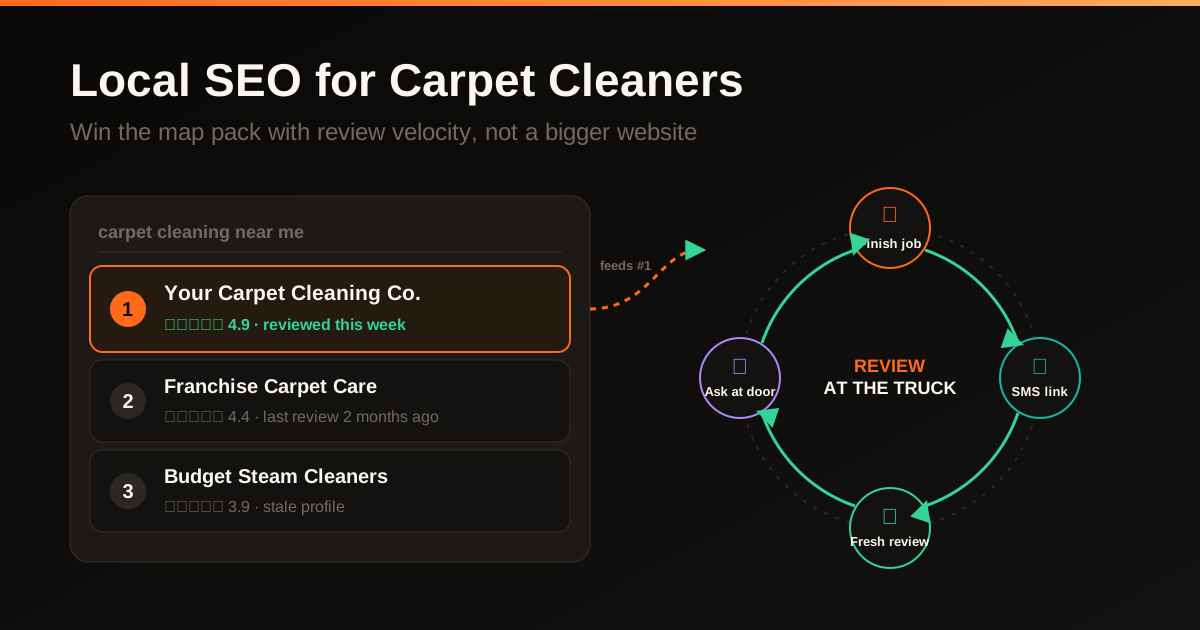
Here is a scene that plays out in every contractor market in America. Two roofers serve the same zip codes. Both do quality work. Both show up on time. Both charge fair prices. One has 14 Google reviews and a 4.6-star rating. The other has 214 reviews and a 4.9. When a homeowner searches 'roofer near me,' they see both listings side by side in the map pack. They tap the one with 214 reviews without a second thought. The other roofer never gets considered. Not because he is worse at roofing, but because he is worse at asking for reviews.
- Ranks at the top of the map pack
- Earns trust before the homeowner clicks
- Converts more clicks into phone calls
- Gets the job and another review to ask for
- Buried below the three-pack
- Looks risky next to a 4.9 with 214 reviews
- Never even gets considered
- Wonders why the phone stopped ringing
Reviews help customers evaluate past experiences, and Google identifies reviews as one part of local prominence. More reviews do not automatically produce higher placement, more calls or more revenue. Keep feedback genuine and assess outcomes separately.
Why Google reviews matter more than your website
Google includes reviews in its explanation of local prominence, alongside other factors. It does not state that a strong review profile always outweighs distance, relevance, website quality or other signals.
Customers may read both recent and older reviews, including how the business responds. Do not treat older feedback as worthless or apply an unattributed survey percentage to every market.
Use a simple, neutral request and a direct review link. Track eligible requests and actual responses without a promised rating, completion time or universal conversion rate.
Then there is the conversion layer. A homeowner who lands on a Google Business Profile with 200 five-star reviews, recent photos, and a responsive owner does not shop around. They call. The decision is made before they ever visit your website. For emergency searches like 'plumber near me' or 'roof leak repair,' most customers call directly from the listing without visiting any website at all. Your reviews are not supporting your marketing. They are your marketing.
The math: how many reviews do you actually need
Forget round numbers and arbitrary goals. The only number that matters is whatever your top three map pack competitors have. Open Google, search your primary keyword ('deck builder near me,' 'roofer near me,' 'pool builder [your city]'), and count the reviews on the three businesses that show up in the map pack. That is your benchmark.
In most mid-size markets, the map pack leaders have between 80 and 200 reviews. In competitive metros like Dallas, Phoenix, or Tampa, the leaders often have 300 to 500. In smaller towns, 40 to 60 reviews might be enough to dominate. Whatever the number is, you need to match it and then keep pulling ahead, because your competitors are collecting reviews too. This is not a finish line. It is a rate.
Set an initial process target for eligible requests, then observe participation. For example, 20 requests yielding 4 reviews is a 20% response rate for that sample. This is illustrative arithmetic, not an expected rate; customers choose whether and what to review.
We built a complete 90-day review engine framework with templates, timelines, and automation triggers. This article covers the why and the what. That one covers the how, step by step.
Read the full review acquisition playbookStep one: ask at the moment of peak satisfaction
Timing is the single biggest variable in whether a customer leaves a review. Ask at the right moment and your conversion rate doubles. Ask at the wrong moment and you get ignored. The right moment is not 'sometime after the job.' It is the specific point during or immediately after the job when the customer is most impressed.
A useful request identifies the completed service, invites honest feedback and provides a convenient link. It should not ask for a positive rating or pressure the customer to respond immediately.
For a deck builder, that moment is the final walkthrough, when the homeowner steps onto their new deck for the first time and sees the finished product. For a roofer, it is right after the debris is cleared and the yard looks cleaner than before you arrived. For a pool builder, it is the first fill. For a painter, it is when the tape comes off. Every trade has its version. Identify yours and build your ask around it.
The ask itself should come from the person who did the work, not from an office manager or an automated email three days later. The crew lead or the owner, face to face, while the customer is standing in front of the finished product. Something like: 'Hey, I'm really glad you're happy with how this turned out. If you've got 30 seconds, a Google review would mean a lot to us. I'll text you the link right now so you don't have to search for us.' That is it. No speech. No pressure. Just a human moment.
Step two: text the link, not an email
Choose a contact channel the customer has agreed to use and keep reminders reasonable. Measure delivery and response from your own workflow. A claimed 95% SMS open rate or 20% email rate is not a reliable forecast for every review request.
Text and email can both be appropriate depending on permission and customer preference. Keep the request brief, neutral and easy to act on. Do not assume one channel guarantees reviews or that the other wastes most requests.
Send a text message within five minutes of the face-to-face ask, while the conversation is still fresh. The message should be short, personal, and contain one link. Not a link to your Google Business Profile. A direct link to the review form. There is a difference. The direct review link opens Google with the star selector already visible. The customer taps five stars, types a sentence or two, and hits submit. The whole thing takes under 60 seconds.
How to generate your direct Google review link
- Go to your Google Business Profile dashboard.
- Click 'Ask for reviews' (or 'Get more reviews' depending on your interface).
- Copy the link Google generates. It will look something like: g.page/yourbusiness/review
- Shorten it with a simple URL shortener if you want it cleaner in the text message.
- Save that link as a template in your phone, your CRM, or wherever you manage customer communication.
That one link is the entire mechanism. Every complicated review funnel, every review management platform, every multi-step email sequence is trying to do what this one link does natively for free. Get it, save it, and use it on every single job.
Step three: follow up exactly once
Not every customer will leave a review after the first text, even if they said they would. Life gets in the way. They meant to do it, put the phone down, and forgot. One follow-up message 48 hours later recovers a significant percentage of those lost reviews without annoying anyone.
The follow-up should be casual and short. Something like: 'Hi Mike, just following up on the review link I sent after we finished the deck. No pressure at all, but if you get 30 seconds it really helps us out. Here's the link again: [link].' That is it. One follow-up. Not two. Not three. Not a drip sequence. One. If they do not leave a review after the follow-up, move on. Pestering a customer for a review is a reliable way to get a negative one.
If you want to automate this, most CRM tools and many contractor-specific platforms like Jobber, Housecall Pro, or ServiceTitan have built-in review request workflows. Set the trigger to fire when a job is marked complete, and the follow-up to fire 48 hours later unless a review is detected. Once it is set up, it runs on every job without anyone remembering to do it.
Step four: respond to every single review
Respond professionally to acknowledge feedback and address concerns without exposing private details. Replies can help prospective customers understand how the business communicates, but a response is not a confirmed direct ranking factor.
Keep replies relevant to the customer’s experience. Do not turn them into keyword-stuffed marketing copy or claim a guaranteed conversion or ranking lift from responding.
Respond to positive reviews within 24 hours. Keep it personal and specific. Do not copy-paste the same generic 'Thank you for your kind words!' on every review. Reference the actual job. 'Thanks Mike, we loved how the cedar deck turned out, especially with the hidden fasteners you chose. Enjoy it this summer!' That takes 20 seconds to write and it communicates to every future prospect that you remember your customers and care about the work.
Respond to negative reviews even faster. Do not argue. Do not get defensive. Do not explain why the customer is wrong. Acknowledge the concern, apologize for the experience, and offer to make it right offline. Something like: 'I'm sorry to hear that, Sarah. That is not the standard we hold ourselves to. I would like to make this right. Could you call me directly at [phone]?' Most prospects reading a negative review will judge the business by the response, not the complaint. A calm, professional reply to a one-star review can actually build trust.
What will get your Google listing suspended
Google may remove policy-violating reviews or restrict content and accounts. Follow its contribution rules without predicting a fixed penalty or reinstatement timeline.
- Buying reviews from freelancers, agencies, or review farms. Google's detection has gotten aggressive. Fake reviews get removed in batches and the listing often gets flagged.
- Offering discounts, gift cards, or any incentive in exchange for reviews. Google's policy explicitly prohibits incentivized reviews. It does not matter if you say 'leave an honest review.' The incentive itself violates the terms.
- Review gating: screening customers before sending them to Google so only happy ones leave public reviews. Google banned this practice specifically. You cannot filter who gets to leave a review.
- Asking employees, family members, or friends to leave reviews. These are not customers and Google can detect patterns like reviews from the same IP, location, or device.
- Posting reviews on behalf of customers, even with their permission. The review must come from the customer's own Google account.
Google prohibits fake engagement, incentives and selectively soliciting positive reviews. Follow that policy and keep records of a consistent process. Legitimate reviews can still be moderated, so do not promise that honest businesses never experience removals or restrictions.
The compound effect: why review velocity matters
Google does not just count your total reviews. It looks at review velocity: how many reviews you are getting per month, how recent they are, and whether the pace is accelerating or stalling. A business with 200 reviews but nothing in the last three months will lose ground to a business with 80 reviews that is adding 10 to 15 per month. Freshness matters as much as volume.
A consistent request process creates opportunities for feedback; it does not guarantee a doubled review count or a 30-50% increase in calls. Measure requests, responses and qualified inquiries as separate outcomes.
Use the completed-job process to invite honest feedback and learn from it. Avoid depicting reviews, rankings and revenue as an automatic causal loop.
Reviews are one piece of the local SEO puzzle. Our contractor SEO system combines review velocity, Google Business Profile optimization, city pages, and technical SEO into a single engine. See how the pieces connect.
See how local SEO and reviews work togetherWhat your review profile should look like in 6 months
If you start this system today and complete 15 to 20 jobs per month, here is a realistic projection. Month one, you add 8 to 12 new reviews just from cleaning up your process and asking consistently. Month two, the follow-up automation kicks in and you add another 10 to 15. By month three, you are hitting 12 to 18 per month because past customers start seeing your review responses and leaving reviews unprompted. By month six, you have added 60 to 100 new reviews. Your star rating has stabilized at 4.8 or above. Your map pack position has climbed. And your phone is ringing more.
That trajectory is not theoretical. We have seen it play out with real contractor clients across multiple trades and markets. The contractors who build a review engine outperform contractors who spend twice as much on ads but ignore their review profile. Reviews are the one marketing asset that keeps paying after you stop spending.
Quick wins you can do this week
- Generate your direct Google review link from your Google Business Profile dashboard and save it as a text shortcut on your phone.
- Text the review link to every customer you completed a job for in the last 30 days. You will pick up 5 to 10 reviews from customers who would have left one if you had asked.
- Respond to every existing review you have not responded to yet. Start with the most recent and work backward. Personalize each response.
- Set up an automated text workflow in your CRM or contractor software to send the review link when a job is marked complete, with a single follow-up 48 hours later.
- Print a small 'Leave us a review' card with a QR code linking directly to the review form. Hand it to the customer at the end of every job, in addition to the text.
Reviews are the accelerant, but the engine needs more. Read how deck builders combine reviews, city pages, Google Business Profile, and citations into a full local SEO system.
See how reviews fit into the full local SEO pictureThe bottom line
Genuine feedback is useful evidence for customers and a source of operational learning. A higher review count does not prove one contractor is better or that every marketing dollar becomes more productive.
Invite honest feedback after eligible work, provide an appropriate link, use a reasonable reminder if needed and respond professionally. Customers decide whether to participate; reviews, rankings and calls are not guaranteed.
Lead & Local Growth and Local Authority include GBP management and a review request and response workflow alongside paid acquisition. Start with a free strategy call and initial audit to understand the priorities for your business.
30 minutes. We will audit your review profile, show you where you stand against your map pack competitors, and map out the 90-day review engine. No pressure, no obligation.
Book a free discovery callSources and further reading
- Google Search: SEO Starter Guide
Crawlable links, descriptive page information and content organization. Practical trade examples are SF Web Tech recommendations.
Source checked .
- Google Business Profile: local ranking guidance
Google’s broad relevance, distance and prominence guidance. No exact ranking weights or guaranteed service-area coverage are stated.
Source checked .
- Google Maps: prohibited and restricted content
Rules against fake engagement, incentives and selectively soliciting positive reviews.
Source checked .