A deck buyer may compare materials, project examples, process and local availability before arranging a consultation. A useful local presence supports that research. Do not assume every project is decided from a map listing within two minutes.
If your deck company isn't one of those three, you didn't lose the job. You were never in the running for it. The homeowner never saw you. And the brutal part is that the builder who got the call usually isn't better at building decks. They're just better at local SEO. This guide is the complete 2026 playbook for becoming one of those top three businesses: how the map pack actually works, what you can control, and how we've done it for real deck and outdoor-living clients.
Track how visitors reach the business, what they request and whether the inquiry fits the service area and project scope. There is no universal deck value or fixed map-click distribution to use as a forecast.
Why local SEO matters more for deck builders than almost any other marketing
Decks are a high-intent, local, high-ticket purchase, which is the perfect storm for local SEO. Nobody searches 'deck builder near me' to browse. They search it because they're ready to spend real money and they want someone close enough to come measure the yard this week. There's no impulse, no awareness problem to solve. The demand already exists; the only question is who captures it.
A nearby search can represent early research or a ready-to-book consultation. Explain the actual service area and scope. Use contribution from completed jobs to assess acquisition costs rather than assuming one contract pays for a year of marketing.
And the geography is unforgiving in your favor. A homeowner in your town will never hire a deck builder three states away, which means your real competition isn't every deck company in America. It's the handful in your service area. That's a fight you can actually win. The map pack (those top three local listings with the map) gets the overwhelming majority of clicks for 'near me' searches, and the businesses below it fight over the scraps. Get into the top three and you're not competing with the internet; you're competing with two other local builders.
Map and organic results can both contribute to discovery. Review the actual queries and qualified inquiries for your market instead of applying an unsupported percentage split to the top three listings.
This guide covers the what and why. If you want to see the complete system we run for deck builders and other trades, including map-pack dominance, city pages, reviews, and attribution, start here.
See the full contractor SEO systemStep one: optimize your Google Business Profile like it's your storefront
Your Google Business Profile (GBP) is the single most important asset in local SEO. It's the listing that shows up in the map pack and on Google Maps, and for a deck builder it does more selling than your website does. Most builders claim it, fill in the basics, and never touch it again. That's the gap you exploit. Treat it like a content channel, not a one-time form.
- Primary category set to 'Deck Builder'
- 5-10 fresh project photos every month, town named in the caption
- A GBP post published every single week
- Q&A pre-seeded, every service area listed
- Vague category like 'Contractor' or 'Construction'
- A logo and a stock photo, nothing new in over a year
- Zero posts, blank Q&A, no service areas
- Invisible to homeowners ready to build right now
Choose accurate available categories, show genuine projects and keep services, hours and contact information current. Use supported profile features and invite honest feedback. Neither service-area names nor a weekly posting schedule guarantees rankings in each town.
Every field, photo, and post that moves the map pack for contractors
Get the full GBP optimization guideHow map pack rankings actually work: proximity, relevance, prominence
Google ranks the local pack on three factors, and understanding them tells you exactly where to spend your effort. Proximity is how close your business is to the person searching. Relevance is how well your profile and website match what they searched. Prominence is how well-known and trusted your business appears to be across the web.
Google identifies relevance, distance and prominence as broad local factors. Better information and evidence can help customers evaluate the business, but do not guarantee placement beyond a competitor’s immediate neighborhood.
- Proximity (you can't control it): your physical location relative to the searcher. The lever you do have is service-area coverage and city pages so you're eligible across a wider radius.
- Relevance (you control most of it): primary category, services listed, and on-page content that matches 'deck builder [city]' searches.
- Prominence (you control it over time): review count and velocity, citation consistency, backlinks, and overall web presence.
Time your SEO to the deck season before it arrives
Deck demand is seasonal, but rankings are not. Searches for 'deck builder near me' climb through the spring and peak in early summer, then taper off as the weather turns. The trap is treating local SEO like a seasonal ad spend you switch on when the phone goes quiet. It doesn't work that way. SEO takes months to compound, so if you start the work in spring you're already too late for the season you wanted to capture.
Use the slow months as the build season for your visibility. Winter is when you stack reviews, refresh your photo library, publish city pages, and clean up citations, so by the time homeowners start searching in March, your map-pack position is already locked in. And unlike paid ads, those rankings don't disappear when the season ends; they hold year-round and compound into the next spring.
Local citations and NAP consistency: boring, required, and a real multiplier
Maintain accurate business details across relevant listings. Legitimate tracking numbers are not automatically inconsistent or harmful when configured around a stable business identity. Correct real errors rather than chasing identical punctuation everywhere.
Prioritize useful, relevant listings and directories the business is eligible to join. Avoid bulk link schemes and a fixed citation-count promise.
- Tier 1 (essential): Google Business Profile, Bing Places, Apple Maps, Yelp, Facebook, and the Better Business Bureau.
- Tier 2 (industry + home services): Houzz, Angi, HomeAdvisor, Thumbtack, Porch, BuildZoom, and the North American Deck and Railing Association (NADRA) directory.
- Tier 3 (local relevance): your chamber of commerce, local newspaper business directories, and county or regional business listings.
- Skip everything else, especially anything charging a fee to 'feature' you on a directory nobody searches.
Review generation: the fastest lever a deck builder has
Invite honest customer feedback consistently. Review recency and volume are not a published formula that guarantees one deck builder outranks another.
The trick is to make asking systematic instead of leaving it to memory. Decks have a perfect natural trigger: project completion. The day the homeowner walks out onto their finished deck for the first time is the day they're happiest with you, so that's when the ask goes out.
- Trigger on completion: the moment a project is signed off, an SMS goes out with a one-tap link straight to your Google review form. Remove every step of friction you can.
- Follow up once: if there's no review after three days, send a single gentle reminder. One follow-up roughly doubles response rates without being annoying.
- Ask for specifics: nudge customers to mention the town and the type of deck ('composite deck in Doylestown'). Those keyword-rich reviews reinforce your relevance for exactly those searches.
- Reply to every review, including the five-stars, within 48 hours. Google logs your response rate as a quality signal, and prospects read your replies as closely as the reviews.
Service-area pages: a dedicated page for every town you serve
Generic 'service area' pages that list 30 towns in a paragraph are dead. Search intent is hyper-local: a homeowner searches 'deck builder Doylestown PA,' not 'deck builder Bucks County.' If your site doesn't have a real Doylestown page, you're not eligible to rank for that searcher, and the builder who built that page is.
A town page should add genuine project or coverage information and cite any local process it describes. When that evidence is unavailable, use a clear service-area overview instead of publishing name-swapped pages.
The fix is one substantial, genuinely useful page per priority town. Not thin, spun copy, but real pages. Each one should carry locally-shot project photos from that town, town-specific permit notes, the neighborhoods you serve, reviews from local customers, and a clear call to action. We took this exact approach for our pool-builder and roofing clients, and the same page-per-town playbook maps almost one-to-one onto decks. By building a dedicated page per priority city, you become eligible across your whole footprint instead of just your home town.
Pavers, retaining walls, and outdoor living rank the same way decks do
See the hardscaping local SEO playbookOn-page SEO for deck builders: title tags, schema, and project galleries
On-page SEO is how you tell Google what each page is about and back up the relevance you're claiming. None of it is complicated; it's just consistently done. The fundamentals that move the needle for deck builders:
Use descriptive headings, accessible project photos and a working contact route. Any structured data should match visible facts and supported eligibility; it is not a substitute for useful content or a guaranteed ranking tool.
Keep business markup truthful and current. Do not promise Google review stars for self-serving business reviews or FAQ rich results for a contractor site. Use actual project stories and helpful navigation, and test mobile usability separately from ranking outcomes.
What local SEO costs for a deck builder
We publish our pricing openly because hiding it behind a 'book a call' button is exactly the kind of thing that makes contractors distrust agencies. Three packages, all month-to-month, no setup fees, cancel anytime. You can see the full breakdown on our pricing page, but here's the short version:
- Lead Launch, $1,500/mo: Paid acquisition for established businesses with capacity for more inquiries.
- Lead & Local Growth, $2,000/mo (Recommended): Paid leads alongside a custom website and ongoing local marketing assets you own.
- Local Authority, $3,500/mo: Expanded useful content and local coverage for businesses ready for a larger ongoing program.
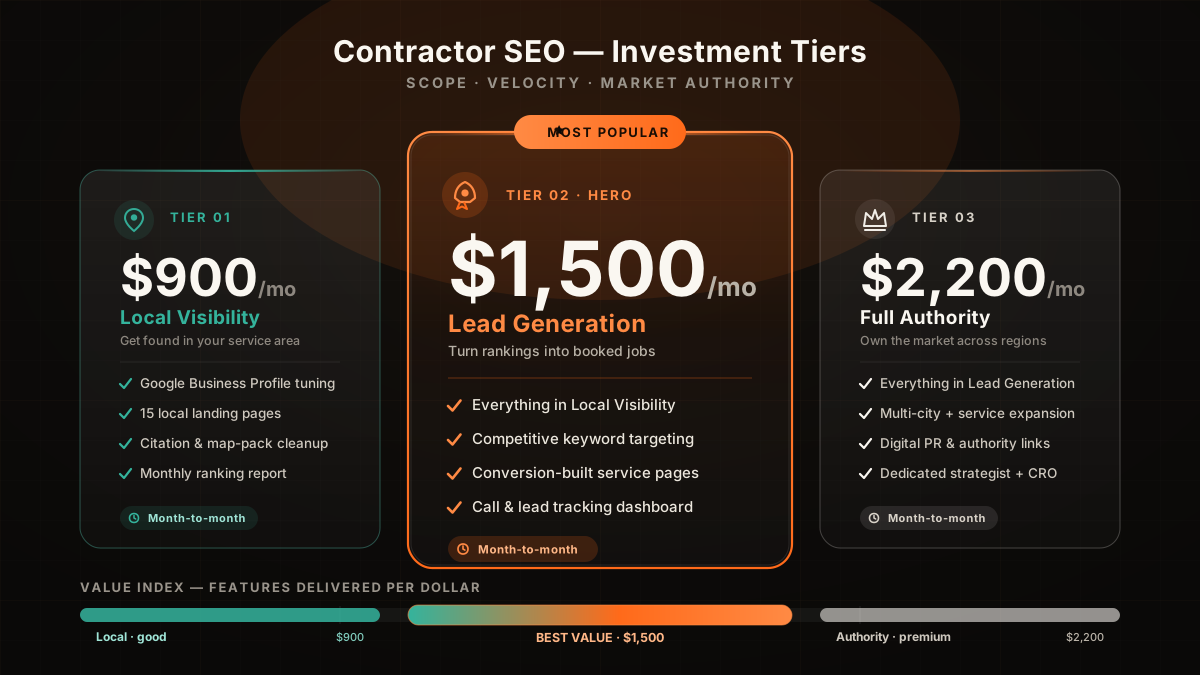
Compare the full marketing expense with contribution from completed work. Contract revenue is not profit, and one deck project does not automatically fund a year of service. Advertising is paid separately from the package fee.
Real results: what this looks like for actual deck companies
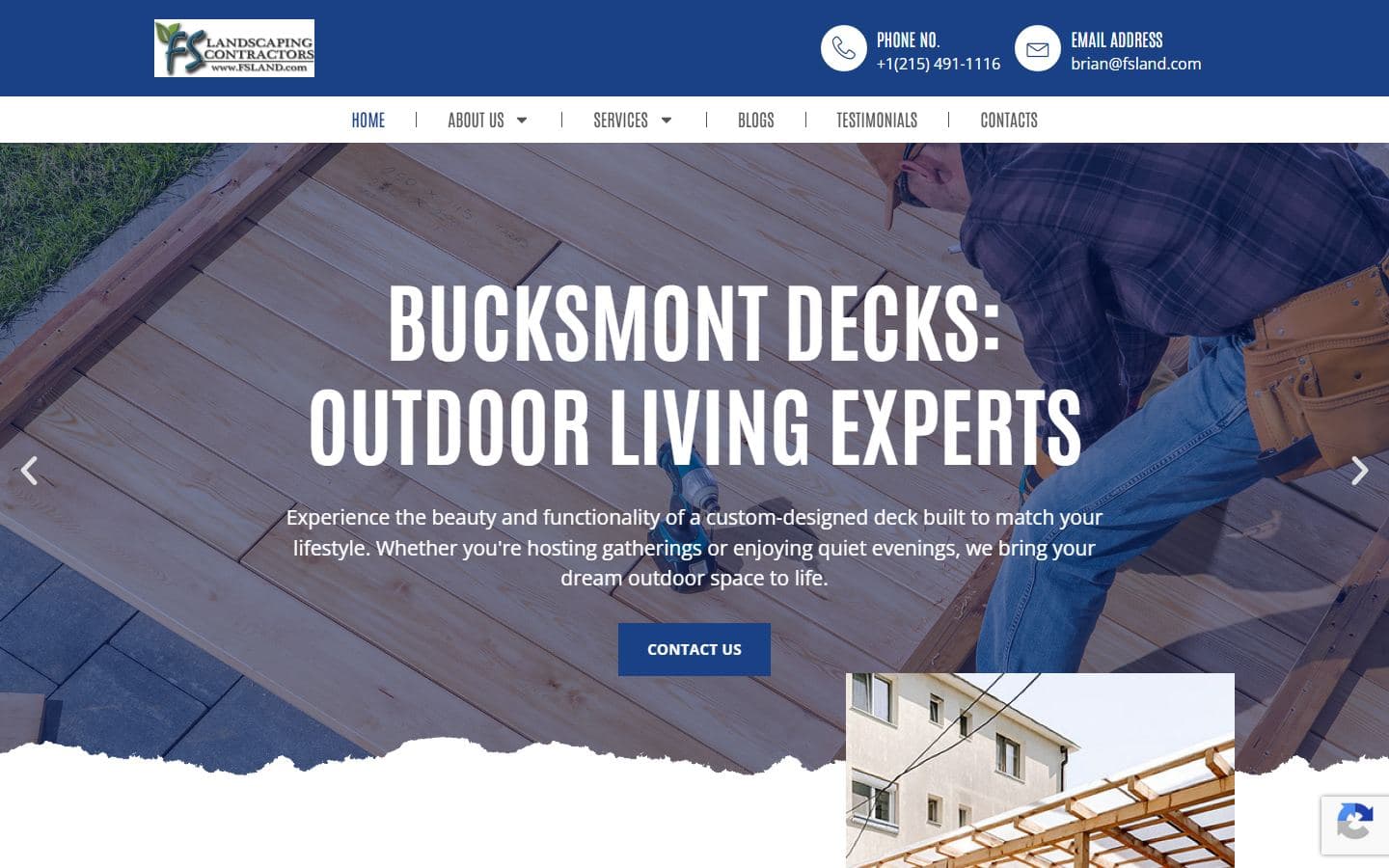
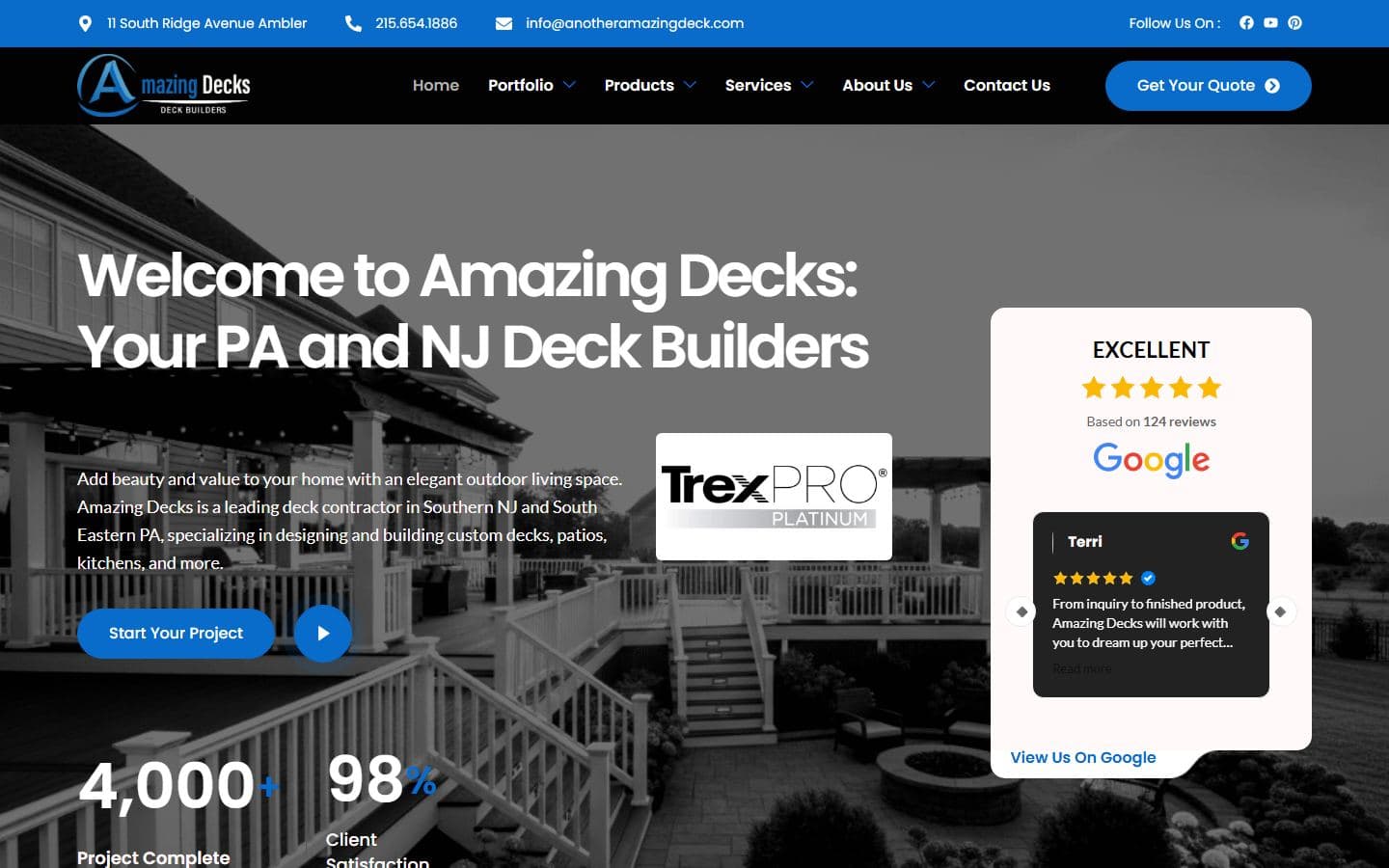
We don't run hypotheticals. On the organic side, we run local SEO for Bucksmont Decks and Amazing Decks, both deck and outdoor-living builders competing in crowded suburban markets. The pattern is the same one this guide describes: a relentlessly optimized Google Business Profile, a steady review engine tied to project completion, dedicated city pages for every priority town, and clean NAP across the web. The result is map-pack visibility in their core towns and a phone that rings with homeowners who are ready to build.
Our portfolio covers deck and outdoor-living projects, including an e-commerce lighting business. Compare the nature and measurement of the work before using any historical example to evaluate your own campaign.
Truscapes Deck Lighting is an e-commerce portfolio project, with different attribution and sales economics from a deck builder. Your written target should be based on your own market, qualification rules and budget rather than borrowed revenue multiples.
30 minutes. We'll audit your map-pack standing in your top 3 towns, look at your Google Business Profile and reviews, and tell you exactly what's holding you out of the top three.
Book a free discovery callThe bottom line
Deck buyers are the easiest customers in home services to win, because they've already decided to spend the money. They just need to find someone close and trustworthy. Local SEO is how you make sure that someone is you. Win the map pack with a living, breathing Google Business Profile, a review engine that never stops, a real page for every town you serve, and consistent business info across the web. Do that, and 'deck builder near me' stops being a search you lose and becomes the most reliable lead source you have.
None of this is complicated. It's just done consistently, every month, by someone who treats it as the priority, which is exactly the problem, because you're busy building decks. That's the part we handle. If you want to see where you stand and what it would take to own your service area, the next step is a quick call.
Tell us your top towns and we'll show you exactly where you rank today and what it takes to get into the top three. No pressure, no pitch deck.
Book a call with SF Web TechSources and further reading
- Google Search: SEO Starter Guide
Crawlable links, descriptive page information and content organization. Practical trade examples are SF Web Tech recommendations.
Source checked .
- Google Business Profile: local ranking guidance
Google’s broad relevance, distance and prominence guidance. No exact ranking weights or guaranteed service-area coverage are stated.
Source checked .
- Google Maps: prohibited and restricted content
Rules against fake engagement, incentives and selectively soliciting positive reviews.
Source checked .
- Google Search documentation updates: FAQ retirement
Google states FAQ rich results stopped appearing May 7, 2026; useful visible FAQs remain appropriate for readers.
Source checked .
- Google Search: review snippet guidelines
Restrictions on self-serving LocalBusiness and Organization review snippets.
Source checked .