A homeowner two townships over just noticed rust-colored rings around every sink in the house. Their coffee tastes like a penny, the white towels are turning orange, and the dishwasher that was fine last spring now leaves grit on the glasses. They pull out their phone and type 'why is my water staining everything.' They do not type 'water softener company.' They have no idea that is what they need yet. Whoever owns the answer to that first panicked search owns the sale.
Well-water customers may describe a concern before knowing what service is appropriate. Explain the assessment process and route health or water-safety questions to authoritative testing guidance. Symptom language can help navigation, but cannot establish contamination or prescribe treatment.
Confirm where the actual customers and service routes are before choosing a content structure. Wells can serve different property settings; do not assume every prospect lives outside a city or that near-me search follows a separate ranking system.
Why 'rank for your city' fails well water companies
Public water comes from a municipal utility. Private wells do not. That single fact reshapes your whole geography. Around 13 million US households get their water from private wells (USGS private well data), and those households are not clustered downtown. They sit on acreage, along rural routes, in exurban subdivisions and farm townships spread across whole counties.
So when you build your site around one city landing page, Google reads you as a city business. Meanwhile your actual customer is searching from a ZIP code with 4,000 people in it and no city center at all. The 'near me' signal that a suburban plumber loves is thin and scattered out here, which is exactly why the trades that win rural markets stop chasing the city and start owning the county.
There is an upside hiding in this that no suburban trade gets to enjoy, and it is the single biggest reason to take this seriously.
Build a service-area architecture organized by county
Explain genuine coverage clearly. A county or township page should provide distinct service or project information. Use a service-area overview where separate pages would only repeat names, and leave water-safety conclusions to appropriate testing.
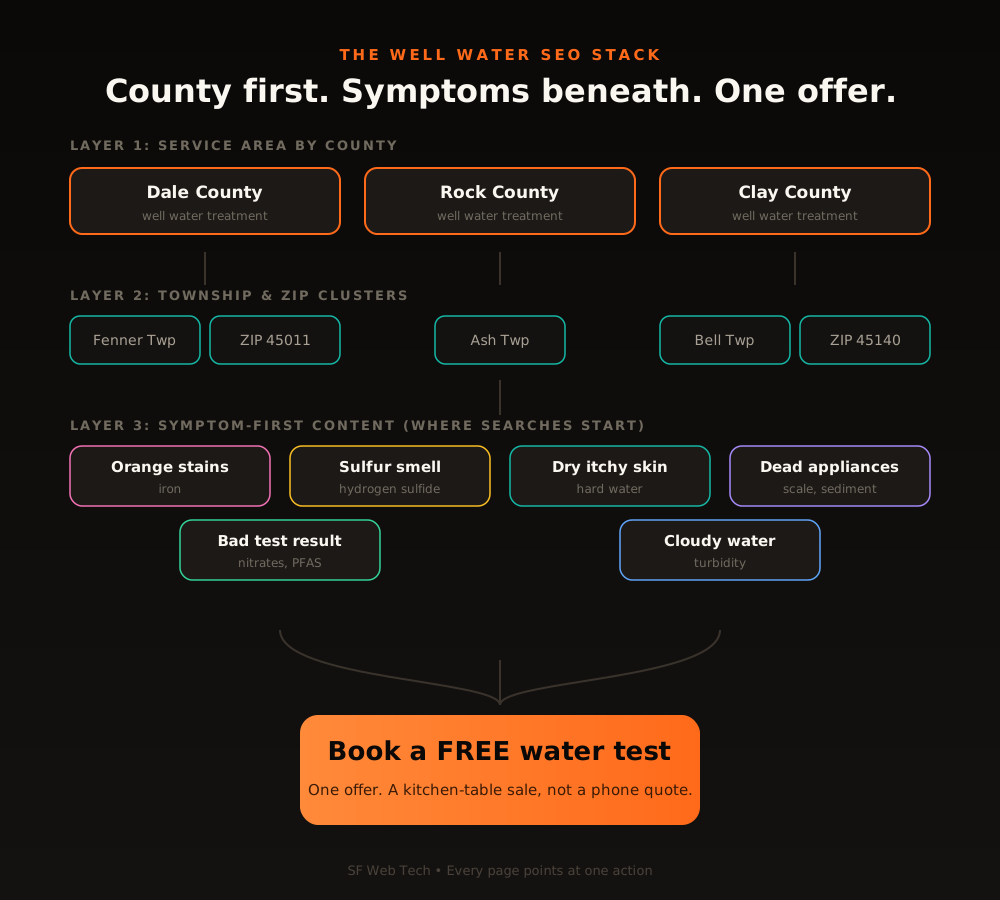
- List every county you actually service, then the townships and ZIP clusters inside each one. This is your map, not a guess.
- Give each county its own page with unique content: the water problems common to that county's geology (iron, sulfur, hardness, nitrates), the towns you cover, and local proof.
- Nest township and ZIP-cluster pages under the county they belong to, so your URL structure reads like your service map.
- Name pages by the term a well owner would search: 'well water treatment in [County]', not 'Service Area 7'.
- Put a real address and service radius on your Google Business Profile, then let the county pages carry the places you cover but do not have a storefront in.
The closest trade to yours is septic service: same rural buyer, same county-shaped market, same 'no downtown' geography. If you want to see this county-first architecture applied end to end, the septic playbook maps almost one to one onto water treatment.
The closest analog to well water: rural, county-shaped, low-competition
Read the septic county-geography playbookThe symptom-first content layer that actually ranks
Well water is invisible until it is not. Nobody wakes up wanting a water softener. They wake up to orange stains, a rotten-egg smell, itchy skin after every shower, or a water heater that died three years early. The winning content is not your service pages. It is the layer of problem pages sitting beneath them, written in the exact words a frustrated homeowner types before they know your industry exists.
Each symptom page does the same job: name the problem in the homeowner's language, explain the likely cause, and route them to a free water test rather than a hard sell. The service pages ('water softeners', 'reverse osmosis', 'iron filtration') still exist, but they sit above the symptom layer and catch the buyer once they know what to ask for.
Combine clear service pages with responsible answers to common testing and assessment questions. Explain what requires a qualified test and what the business actually offers. Avoid fear-based copy, unsupported low-competition claims or advertising a free test unless that is the real offer.
County architecture, symptom content, and Map Pack ranking, done for you
See how we structure Local SEO for home-service tradesWinning Google Maps when your buyers are spread across counties
You still need the Map Pack, the three-business box that shows up on a local search. It just works differently when your service radius covers whole townships instead of a few suburban blocks. Set your Google Business Profile up as a service-area business, define the radius honestly, and let your reviews and county pages do the geographic heavy lifting.
Use an accurate service-area profile configuration for the business model. Publish genuine job photos with permission and invite honest reviews without selecting only happy customers or prescribing place names. State contact and appointment options that are currently supported.
Reviews are the fuel here. A rural water company with steady, place-specific reviews will out-rank a bigger competitor coasting on an old profile, because Google reads recent, geographically anchored reviews as proof you actually serve that ground.
The GBP checklist that moves contractors into the Map Pack
Optimize your Google Business Profile the right wayThe free water test is the best lead magnet a rural trade can run
Here is where well water beats almost every other home service. Your lead magnet is not a coupon or a phone quote. It is a free in-home water test. It costs you almost nothing, it hands the homeowner something genuinely valuable, and it puts you at their kitchen table with a test kit and their actual results in front of both of you. That is not a phone quote. That is a sale in progress.
“The free water test is not a gimmick. It is how the best water treatment companies in the country generate the majority of their leads: it costs almost nothing, gives the homeowner something valuable, and puts you face to face with a qualified prospect.”
So every symptom page, every county page, and every Map Pack listing should point at one action: book a free water test. Not 'request a quote'. Not 'call for pricing'. The test is the offer, because once you are standing in their kitchen showing them why their water stains, the softener sells itself.
Your 30-day well water SEO playbook
- Map your real service area by county, then township, then ZIP cluster.
- Build one strong page per county with unique local water content and the towns you cover.
- Set your Google Business Profile to service-area, define your radius, and start collecting place-specific reviews.
- Publish your first five symptom pages: orange stains, sulfur smell, hard-water skin, dying appliances, bad test results.
- Point every page at one call to action: book a free in-home water test.
- Add township and ZIP pages under each county as you confirm you serve them, and keep the symptom layer growing.
We build the county architecture and symptom layer for home-service trades
Book a call and map your county-first SEO planYour buyers are out there right now, staring at an orange stain and typing a question into their phone. The only question that matters is whether the answer they find has your name on it. Build the county pages, write the symptom layer, and make the free water test your one and only offer. That is how a rural water treatment company wins a market nobody else even knows how to search.
Sources and further reading
- Google Search: SEO Starter Guide
Crawlable links, descriptive page information and content organization. Practical trade examples are SF Web Tech recommendations.
Source checked .
- Google Business Profile: local ranking guidance
Google’s broad relevance, distance and prominence guidance. No exact ranking weights or guaranteed service-area coverage are stated.
Source checked .
- Google Maps: prohibited and restricted content
Rules against fake engagement, incentives and selectively soliciting positive reviews.
Source checked .
- EPA: protect your home’s water
Private-well testing and water-quality guidance; symptoms alone do not establish safety or a treatment prescription.
Source checked .