Every contractor who asks 'is SEO worth it?' has usually already been burned, or watched a buddy get burned. They paid someone $1,500 a month for a year, got a dashboard full of 'impressions,' and couldn't point to a single job it booked. So the question isn't really 'does SEO work.' It's 'will it work for me, and will I be able to tell?' Fair question. Let's answer it with numbers instead of promises.
Here's the honest version up front: for most established contractors, SEO is one of the highest-return marketing channels available, because you stop renting leads and start owning the pipe they come through. But it isn't right for everyone, it isn't instant, and there are real scenarios where we'll tell you not to bother. This breakdown covers all of it: what you actually get, how it compares to the shared-lead platforms and Google Ads you're probably already paying, the real timeline, and when it's a bad idea.
What contractors actually get from SEO
Strip away the jargon and SEO does three concrete things for a contractor. It puts you in the Google map pack (the three businesses with the pins that show up when someone searches 'deck builder near me'). It ranks your service and city pages so you show up in the regular results below that. And it builds you a website and review profile that turns those clicks into phone calls and form fills. That's it. No magic, just being the contractor people find and trust when they're ready to hire.
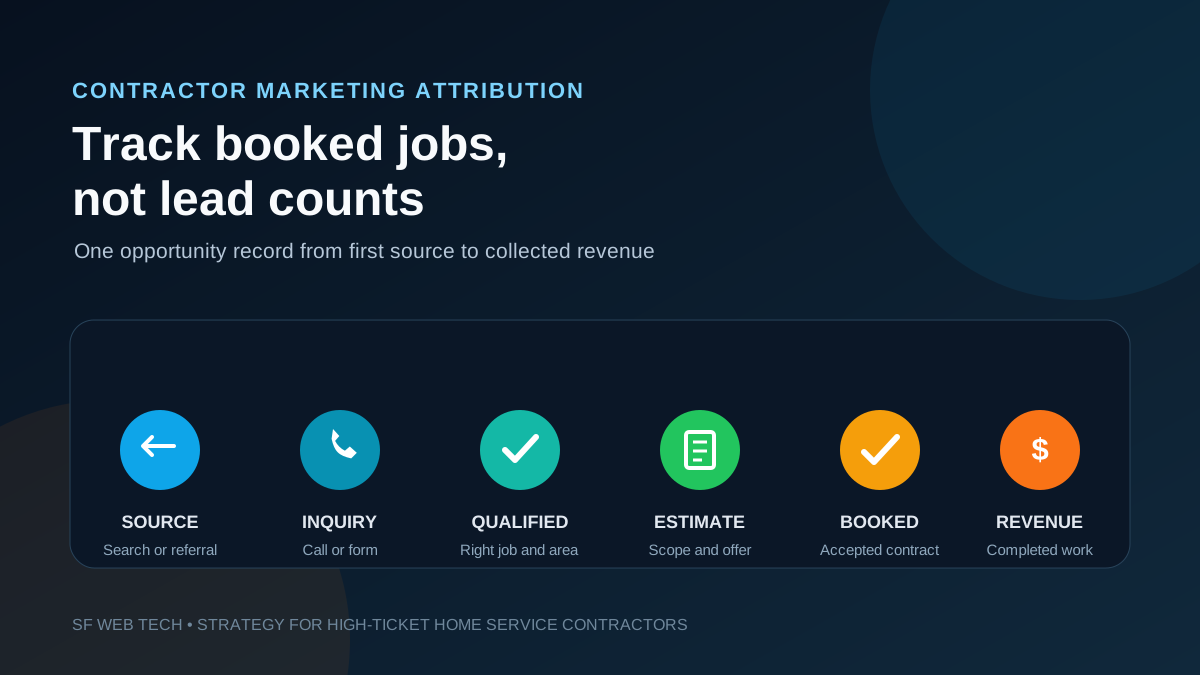
An inquiry through your own website is not a lead you bought from a shared-lead seller. The homeowner can still contact other contractors, so organic search does not make the customer exclusive to your business. Clear service information, credible evidence, and timely follow-up remain important.
Organic marketing can contribute inquiries, but the volume and timing depend on demand, competition, the website, and the offer. Evaluate relevant search data alongside a qualified-lead register. Do not assume that steady work necessarily produces a fixed upward curve or enough jobs to fill a calendar.
SEO can support discovery through useful pages and an accurate local presence. You own delivered website assets, but not search rankings. Track attributable inquiries where possible and keep unknown sources separate. Future leads are not guaranteed, and a prospect may also contact competitors.
SEO vs. shared lead platforms (Angi, Thumbtack, HomeAdvisor)
Compare any lead provider using its current written pricing, exclusivity terms, credit rules and actual close rates. Those terms vary. Do not assume every platform charges the same range or sells every lead to the same number of contractors.
Run the math over a year. A contractor buying shared leads aggressively can easily spend more on per-lead fees than a full SEO program costs, and at the end of that year, they own nothing. Stop the payments and the leads stop the same day. The contractor who invested the equivalent into SEO has rankings, a content library, and a review engine that keep producing jobs into year two and beyond at a lower and lower cost per booked job. Shared leads are a treadmill. SEO is a staircase.
Shared platforms aren't useless, they're a fine way to fill gaps while your SEO matures, and we tell new clients exactly that. But as a permanent strategy they're a trap, because the platform owns the relationship with the customer, sets the price, and can change the rules whenever it wants. The whole point of SEO is to get off that treadmill.
30-min strategy session, no obligation
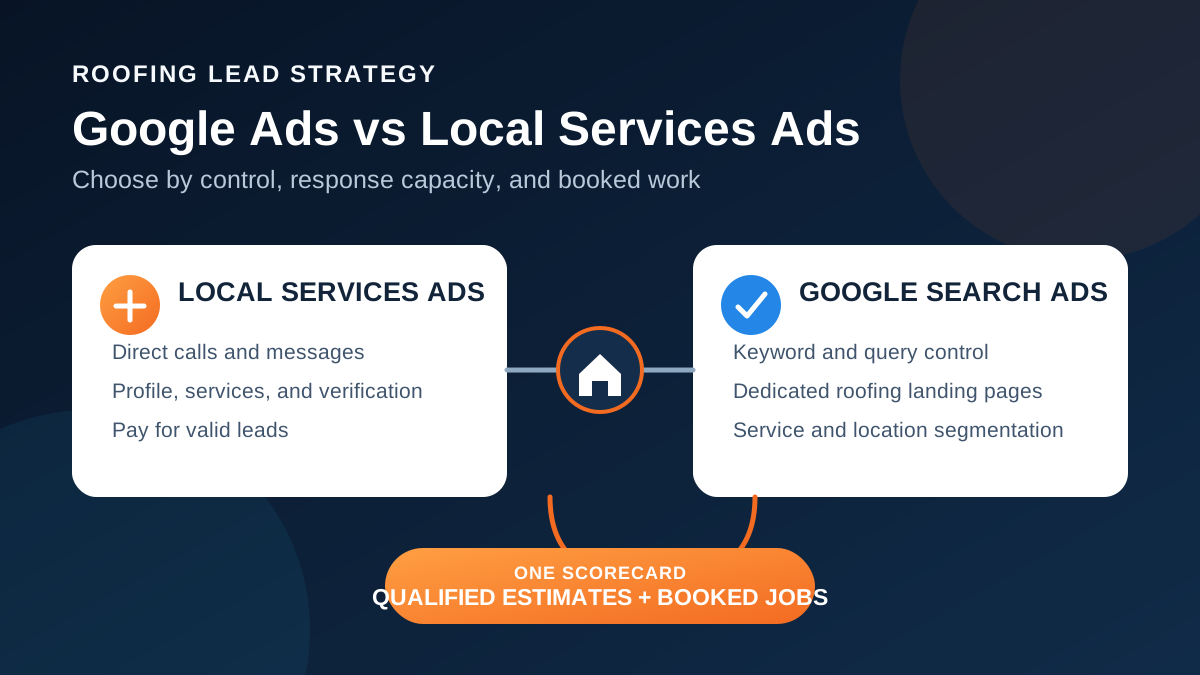
Book your free discovery callSEO vs. Google Ads, and why the best answer is both
People treat this like an either/or. It isn't. Google Ads and SEO solve different problems and the smart move is to run them together, with the balance shifting over time. Ads buy you the top of the page today, you pay per click, the phone rings this week, and the moment your budget runs out, so does the traffic. SEO earns you that visibility for free over months, and keeps it after you stop spending. One is a faucet, the other is a well.
So the right play for most contractors is to start ads on day one to generate jobs while SEO is still climbing, then let SEO carry more and more of the load as it matures, which lets you dial ad spend down to the most profitable searches instead of paying for every click. We wrote a full SEO vs Google Ads comparison with the cost-per-lead math side by side, if you want the detailed version. That's exactly why our Lead Generation package bundles Google Ads management into the SEO program: ads cover the gap in months one through three, and SEO becomes the cheaper, durable channel underneath.
The real timeline, what actually happens, month by month
The single biggest reason contractors think SEO 'didn't work' is that they expected month-one results from a channel that pays off in month six. Here's the honest curve so you can judge progress against reality instead of against a sales pitch.
Begin with technical and contact checks, accurate business information and a useful content plan. Monitor discovery and qualified inquiries as the work proceeds. Organic results may take time and can vary substantially; there is no universal monthly sequence from map movement to cheaper booked jobs.

If you need jobs on the calendar this week, SEO alone won't do it, that's what ads are for. But if you can give it a real runway, the curve bends in your favor and stays there. We break the timeline down in even more detail in how much contractor SEO costs, if you want the full picture before committing.
When SEO is NOT worth it (the honest part)
Plenty of agencies will tell you SEO is right for everyone. It isn't, and pretending otherwise is how people get burned. Here are the situations where we'll tell you to wait or spend your money elsewhere.
- You have zero runway. SEO takes months to pay off. If you can't cover a few months of investment before the leads ramp, run ads or shared leads first, then build SEO once there's breathing room.
- You can't take more work. If you're already booked solid for the season and not hiring, more leads just means more calls you can't service. Fix capacity first.
- You need jobs this week. SEO is a medium-term play. For immediate volume, Google Ads or Local Service Ads will fill the calendar faster while SEO builds underneath.
- You're in an ultra-thin market. If your whole service area has a few dozen monthly searches, the ceiling is low, a tightly targeted ads budget may simply beat SEO on ROI.
- You won't commit to the basics. SEO can't fix a business that won't answer the phone, ask for reviews, or follow up on leads. The marketing only works if the operation does.
Notice what's not on that list: 'your trade is too competitive' or 'your town is too small to bother.' Those are usually solvable with the right strategy. The disqualifiers above are about timing, capacity, and runway, not whether SEO can work in your market.
What it actually costs
Worth-it is a math problem, and you can't do the math without a real number. So here are ours, published, fixed, and the same for every contractor. No 'book a call to get a quote.' Full details are on the pricing page.
- Lead Launch, $1,500/mo: Paid acquisition for established businesses with capacity for more inquiries.
- Lead & Local Growth, $2,000/mo (Recommended): Paid leads alongside a custom website and ongoing local marketing assets you own.
- Local Authority, $3,500/mo: Expanded useful content and local coverage for businesses ready for a larger ongoing program.
All packages are month-to-month with the agreed written terms and no separate agency setup fee within scope. Advertising is separate. Evaluate the total acquisition expense against actual job contribution and close rates; a single large contract does not automatically pay for the program.
Break-even depends on contribution from completed work, the close rate and the full acquisition expense. No generic contractor job automatically pays for the package. Advertising spend is separate from management.
The bottom line
Is SEO worth it for contractors? For most, established crews with steady work, real reviews, and a service area worth owning, yes, and it's usually the highest-return channel they have, because the leads are exclusive and the asset compounds long after the spend stops. For a few, no runway, no capacity, or a need for jobs this week, it's the wrong tool right now, and the honest answer is to fix that first.
“The contractors who win with SEO aren't the ones who spent the most. They're the ones who stopped renting leads, committed to a real runway, and let the asset compound. Twelve months in, they're paying a fraction per job of what their competitors hand to Angi every month.”
The fastest way to know which camp you're in is a 30-minute discovery call. We'll audit where you actually stand, tell you a realistic timeline for your market, and, if SEO isn't the right move for you yet, we'll say that too. No pressure, no jargon, just a straight answer on whether it's worth it for your business.
30-minute discovery call, a real audit of where you stand, and an honest answer on whether SEO is worth it for your market.
Get started with contractor SEOSources and further reading
- Google Search: SEO Starter Guide
Crawlable links, descriptive page information and content organization. Practical trade examples are SF Web Tech recommendations.
Source checked .
- Google Search: creating helpful content
People-first writing, useful original information and the absence of a preferred word count. Does not substantiate a client result.
Source checked .
- Google Maps: prohibited and restricted content
Rules against fake engagement, incentives and selectively soliciting positive reviews.
Source checked .