When comparing agencies, ask for concrete scope, ownership terms, reporting definitions and relevant evidence. Price, a referral or a polished presentation alone does not establish what will be delivered. Use the questions below to make proposals comparable.
Here's the thing: you don't need to become an SEO expert to hire one well. You need a short list of the right questions and the discipline to walk away when the answers are bad. This guide is that list. Seven questions that expose almost everything in a single 30-minute call, seven red flags that should end the conversation immediately, and a clear picture of what a genuinely good contractor SEO agency looks like.
Look for clear work scope, accountable reporting and evidence relevant to your business. A written qualified-lead commitment is different from a guaranteed Google ranking. Read the target, conditions and remedy before deciding whether an offer fits.
Before you vet anyone, it helps to know what 'good' actually delivers. Here's the complete playbook, map-pack dominance, city pages, and attribution.
See the full contractor SEO system firstThe 30-minute vetting framework
You don't need a six-week procurement process to hire an SEO agency. You need one honest conversation. The questions below are designed to be uncomfortable for the wrong agency and easy for the right one. A great agency will answer all seven without flinching, most will actually be relieved you asked. A bad agency will dodge, deflect, or bury you in jargon. Watch how they answer as closely as what they say.
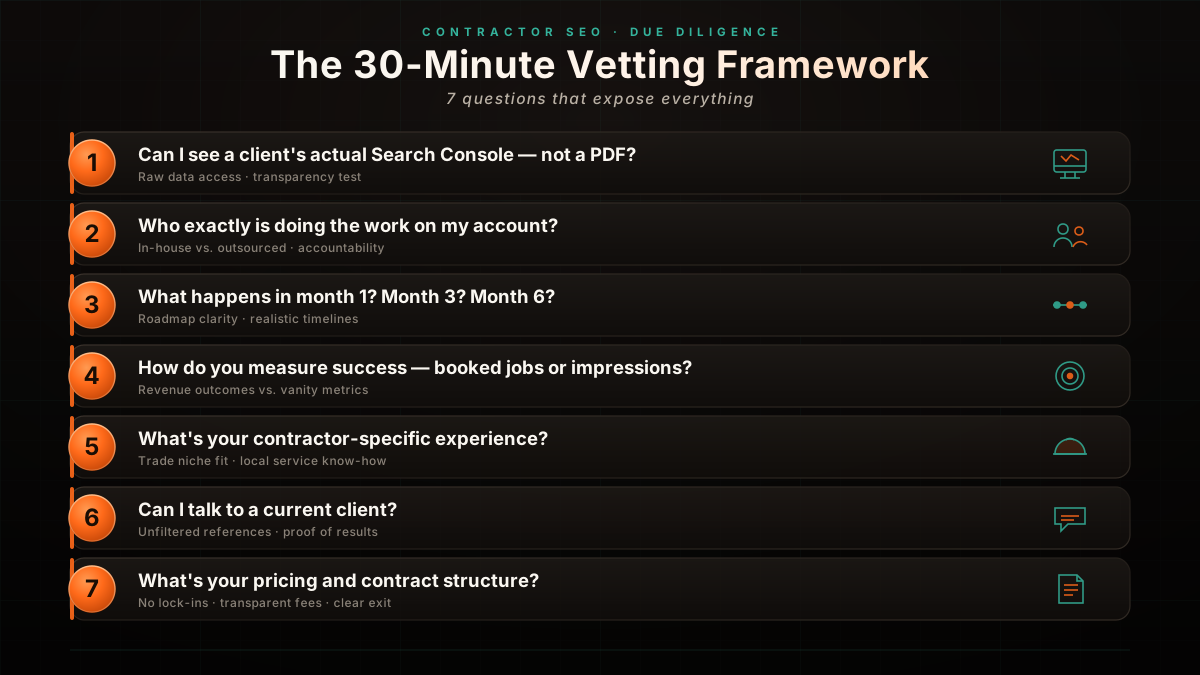
1. "Can I see a client's actual Search Console, not a PDF?"
This is the single most revealing question you can ask, because it's almost impossible to fake live. Anyone can build a pretty PDF report. Very few agencies will share their screen and walk you through a real client's Google Search Console or Google Business Profile insights, actual clicks, actual queries, actual ranking trends over time. If they can show you a live dashboard (with the client's permission), they're doing real work and they know it holds up. If they only have 'sample reports,' assume the reports are the product.
2. "Who exactly is doing the work?"
Ask who will actually be on your account, by name and role. The pattern to watch for: a senior strategist closes the sale, then you're quietly handed off to a junior who rotates out every three months, or worse, an offshore content mill you never speak to. Contractor SEO lives and dies on local knowledge and consistency. You want one accountable person who understands your market, not a rotating cast that re-learns your business every quarter.
3. "What happens in month 1? Month 3? Month 6?"
A real agency has a plan with a shape. Month one is foundation, technical fixes, Google Business Profile, the first city pages. Months three to four is where you should see the first real movement: map-pack changes, early rankings, traceable calls. Months five and six is where it compounds. If the answer is vague ('SEO takes time, you just have to be patient'), that's a stall tactic. Patience is fair, there's a difference between 'results compound over months' and 'we have no plan and we're hoping.'
Ask what work and measurements will be available in each reporting period. Organic timelines vary, so avoid treating either a three-month success promise or a twelve-month statement as proof of competence or dishonesty. Accountability should begin with the agreed delivery and measurement process.
4. "How do you measure success?"
Listen for the difference between vanity metrics and money metrics. 'Impressions,' 'keyword rankings,' and 'domain authority' are inputs, they're nice, but they don't pay your crew. The agencies worth hiring measure success in booked jobs, qualified phone calls, and form submissions you can trace back to organic search. If their definition of winning is a chart that goes up and to the right but never mentions the phone ringing, you're paying for decoration.
5. "What's your contractor-specific experience?"
SEO for a roofer is not the same as SEO for a law firm or an e-commerce store. Home services run on local intent, the Google map pack, service-area pages, seasonal demand, and review velocity. An agency that's only ever ranked national SaaS brands will treat your business like a content blog. Ask specifically: 'Have you ranked contractors in my trade or an adjacent one? Can you show me?' A specialist will have roofing, decks, pools, landscaping, or fencing examples ready. A generalist will change the subject.
6. "Can I talk to a current client?"
Case studies are written by the agency. A reference call is not. A confident agency will happily connect you with a current contractor client who'll tell you the truth, what the communication is actually like, whether the leads are real, whether they'd sign again. If an agency gets cagey about references, or can only offer a 'testimonial' instead of a live conversation, take the hint.
7. "What's your pricing and contract structure?"
Ask for the standard fee, included scope, separate advertising budget and any discount in writing. Our published standard fees are consistent across the website and proposals. Discovery establishes the right scope and lead target; any client-specific discount is documented clearly. Lead Launch is $1,500/month for paid acquisition. Lead & Local Growth is $2,000/month for paid acquisition, a custom website and ongoing local marketing. Local Authority is $3,500/month for expanded content and local coverage. Advertising is separate, starting at $50/day. All packages are month-to-month.
Real 2026 pricing, what drives the number up or down, and an honest comparison against Angi and Thumbtack shared leads.
Read the full contractor SEO cost breakdown7 red flags that should make you walk away
The questions above tell you who's good. These red flags tell you who to avoid entirely. Any single one of these is a reason to slow down and dig deeper. Two or more, and you should be walking toward the door.
Red flag 1: "Guaranteed #1 rankings"
No agency controls Google rankings. A ranking promise differs from a written qualified-lead target with a defined remedy. SF Web Tech agrees a minimum before enrollment and waives subsequent management fees if that cumulative minimum is not met in 90 days; advertising remains separate. Ask what counts, when the clock starts and what happens if the target is missed.
Red flag 2: $299/month "SEO packages"
A low-priced offer may have a narrow scope. Ask exactly what it includes, who reviews the work and how success is measured. Price alone does not prove spam, poor quality or zero value.
Red flag 3: Long-term contracts with no exit clause
If an agency requires a 12-month lock-in with no way out, ask yourself why they need it. Good work retains clients without a cage. Lock-in contracts exist to protect the agency from the consequences of underdelivering. The healthiest structure is month-to-month: it keeps the agency honest because they have to earn next month every single month.
Red flag 4: They can't show you what they're doing
Black-box SEO, 'trust us, we're working on it', is where a lot of contractor budgets quietly die. You should be able to see the pages being published, the links being built, and the reports behind the numbers. If you can't see the work, the safest assumption is that the work isn't happening. Transparency isn't a perk; it's the bare minimum.
Red flag 5: AI-generated content with no human review
AI is a fine tool in the right hands. But an agency mass-producing pages with no local knowledge, no editing, and no understanding of your trade is building a liability. Google increasingly ignores or penalizes thin, generic, machine-spun content, and homeowners can smell it. You want content that names real neighborhoods, real services, and real specifics, written or seriously edited by a human who understands the work.
Red flag 6: They never ask about your business goals
If the entire sales conversation is about keywords and traffic and never once asks 'what kind of jobs do you actually want more of?', that's a tell. The best agencies want to know your highest-margin service, your best service areas, and your capacity, because SEO should be pointed at the jobs you want, not just any traffic. An agency that doesn't care about your business outcomes will optimize for metrics that don't matter to you.
Red flag 7: No local or home-service specialization
We said it above and it bears repeating as a red flag: an agency with no demonstrable home-service track record is learning on your dime. Local SEO for contractors has its own playbook, the map pack, service-area pages, review engines, Local Service Ads. If they can't point to contractor results, you're their experiment.
Ask what ongoing technical or citation maintenance covers and how it is reported. Structured data and business details may need updates as a site changes. Recurring fees should correspond to real work and an agreed scope, rather than being judged fraudulent merely because the initial setup was one-time.
What a genuinely good agency looks like
Strip away the noise and a good contractor SEO agency comes down to four things. Use these as your scorecard.
- Transparency, you can see the work, the data, and the reasoning behind it. Live dashboards, not just polished PDFs.
- Specialization, they've ranked contractors in your trade or an adjacent one, and can prove it with real examples.
- Proof, measurable booked jobs and traceable leads, references you can actually call, case studies with numbers.
- Pricing clarity, a public, honest price and a contract that doesn't trap you. They earn next month by delivering this month.
How SF Web Tech stacks up against the framework
At SF Web Tech, you work directly with Sohail. Start with a free strategy call and initial audit you can keep. We can arrange a reference conversation with an existing client who agrees. Lead Launch is $1,500/month for paid acquisition. Lead & Local Growth is $2,000/month for paid acquisition, a custom website and ongoing local marketing. Local Authority is $3,500/month for expanded content and local coverage. Advertising is separate, starting at $50/day. All packages are month-to-month.
Review our portfolio for relevant types of work, and ask for supporting context before relying on a historical performance claim. Client contact details are shared only with permission. A reference conversation and a clearly defined proposal are more useful than transferring another business’s results to your forecast.
Public pricing, every deliverable spelled out, and the free discovery month that comes before any invoice.
Compare our packages side by sideThe bottom line
Choosing an SEO agency feels high-stakes because it is, the wrong one costs you a year and several thousand dollars you can't get back. But the decision gets simple once you have a framework. Ask the seven questions. Watch for the seven red flags. Hire the agency that's transparent, specialized, provable, and priced honestly. Skip the rest, no matter how good the pitch sounds.
If you want to put a real agency through the test, book a free 30-minute discovery call. We'll audit your market live, show you exactly where you stand, and answer every one of those seven questions on the spot. If we're not the right fit for your business, we'll tell you that too, because the goal isn't to win every deal, it's to be the agency that actually deserved the yes.
30 minutes · a live market audit · the seven questions answered on the spot. No pressure, no obligation.
Book a free discovery callSources and further reading
- Google Search: SEO Starter Guide
Crawlable links, descriptive page information and content organization. Practical trade examples are SF Web Tech recommendations.
Source checked .
- Google Search: creating helpful content
People-first writing, useful original information and the absence of a preferred word count. Does not substantiate a client result.
Source checked .
- Google Maps: prohibited and restricted content
Rules against fake engagement, incentives and selectively soliciting positive reviews.
Source checked .
- Google Search documentation updates: FAQ retirement
Google states FAQ rich results stopped appearing May 7, 2026; useful visible FAQs remain appropriate for readers.
Source checked .
- Google Search: review snippet guidelines
Restrictions on self-serving LocalBusiness and Organization review snippets.
Source checked .