Consider an illustrative dumpster campaign: the owner focuses on lowering cost per click, but the search-term report includes junk removal and free-disposal queries. Those inquiries may be unsuitable when the business rents roll-off containers. Before changing bids, separate the services actually sold from related searches the operator cannot fulfill.
Cost per click is not the number killing your account. The number killing your account is how much of your budget actually reaches someone who wants to rent a can, and how many of those people you close on the phone. A cheap click from the wrong searcher is the most expensive thing in your account, because you pay for it and get nothing back.
Your CPC is high because the category is expensive
Dumpster rental sits in one of the pricier corners of home services. The clicks are not going to be cheap, and no amount of bid tinkering changes that. What you can change is whether every dollar buys a click from a real rental buyer instead of a tire-kicker searching for something you do not even sell.
There is no universal dumpster-rental CPC or minimum profitable budget. Estimate the contribution from a completed rental, the share of qualified inquiries that book and the media cost the business can support. Use the account’s own search terms and completed bookings to test those assumptions.
Accept that a rental buyer costs real money to reach, and the math flips. If your clicks are expensive, you cannot afford to waste a single one on a searcher who was never going to book. That is exactly what happens when you bid on the word dumpster without a firewall around it.
The junk-removal trap that drains dumpster accounts
The word dumpster does double duty in Google. One person types it because they want a container dropped in their driveway for a weekend renovation. The next person types it because they want a crew to show up, load a truck, and haul their old couch away. Same word, opposite service. If your ads answer both, you pay for both, and half of them bounce the second they realize you do not do the loading.
In most dumpster accounts we audit, a meaningful share of spend, often somewhere between a fifth and a third, is going to searches that live on the wrong side of that line. Free dumpster, dumpster diving, dumpster near me for a homeowner who wanted the city to haul trash, and endless junk-removal queries. That spend is not a rounding error. It is the difference between a profitable account and one the owner is about to shut off.
- roll off dumpster rental
- 10 yard dumpster rental near me
- rent a dumpster for a week
- construction dumpster rental prices
- 40 yard roll off rental cost
- junk removal near me
- free dumpster
- haul away old furniture
- dumpster diving
- dumpster rental jobs / how to start
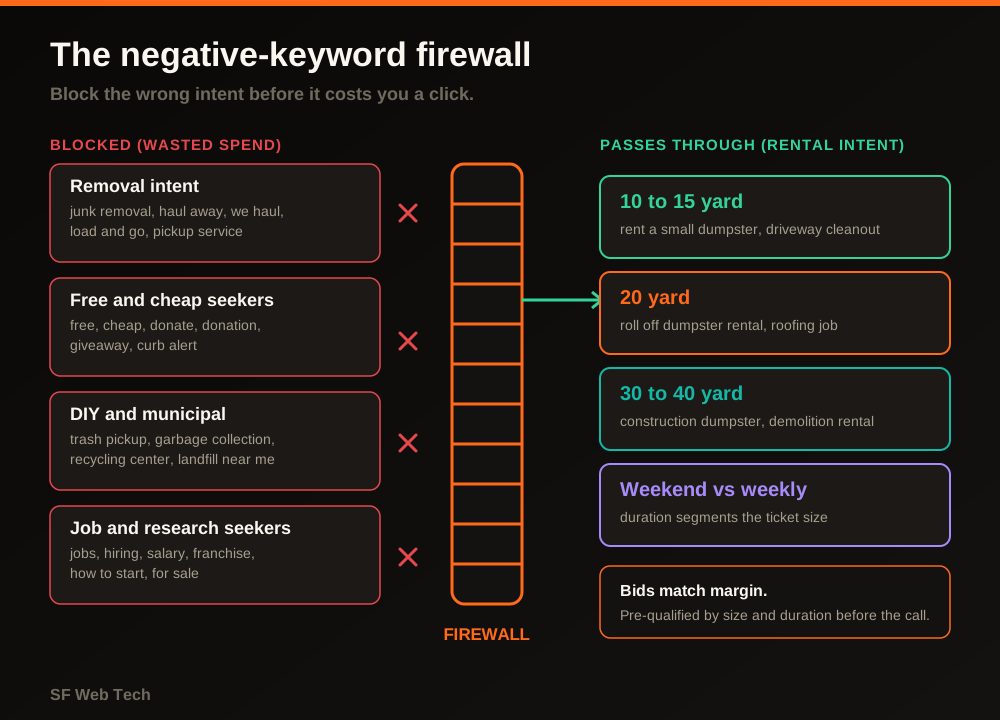
Build your negative-keyword firewall
A firewall is not one afterthought list buried in your campaign settings. It is a maintained shared negative list applied across every campaign, plus weekly reads of the search terms report so new junk gets caught before it drains a week of budget. Start with these buckets.
- Removal intent: junk removal, junk hauling, haul away, we haul, pickup service, load and go.
- Free and cheap seekers: free, cheap, donate, donation, giveaway, curb alert.
- DIY and municipal: trash pickup, garbage collection, recycling center, landfill near me, city bulk pickup.
- Job and research seekers: jobs, hiring, salary, how to start, business plan, franchise, for sale.
- Noise: dumpster diving, dumpster fire, dumpster pool, dumpster meaning.
Firewall build, ad-group structure, and weekly search-term cleanup, done for you.
See how we manage Google AdsStructure ad groups by size and duration, not by keyword blob
Once the wrong buyers are filtered out, the next job is sorting the right ones by how much they are worth. A 10-yard weekend rental and a 40-yard demolition job are not the same customer, and they should not land in the same ad group with the same ad and the same budget. Split them so your message, your landing page, and your bids match the ticket size.
This structure does the pre-qualifying for you. Before anyone picks up the phone, the searcher has already told you their size and duration, which is a rough proxy for their budget. Your bids can lean into the bigger jobs, and your ad copy can stop trying to speak to everyone at once.
“Bidding on the word dumpster with no negative list is paying to advertise your competitor's junk-removal truck.”
Your real problem is close rate, not click price
Here is the part nobody wants to hear. You can build the cleanest firewall and the tightest ad-group structure in your market, and still bleed money if the phone rings and nobody answers, or someone answers and cannot quote a price. Paid clicks are the front half of the machine. The back half is how fast you respond and how well you close.
Do the arithmetic on your own numbers. Take your monthly ad spend, divide by the leads it produced to get a cost per lead, then divide by your close rate to get a true cost per booked job. Move that close rate from one in four to one in three and your cost per job drops hard, without touching your CPC or spending another dollar. That is a far bigger lever than shaving two dollars off a click.
We will pull your search terms report live and show you where the budget is leaking.
Book a strategy callYour 30-day rebuild
You do not need to blow up the account. You need to run these steps in order and give each one a week to gather data before you judge it.
- Week 1: Export 90 days of search terms. Highlight every removal, free, DIY, and job query. Build one shared negative list and apply it everywhere.
- Week 2: Split your ad groups by container size and duration. Write ad copy and a matching landing section for each tier.
- Week 3: Move rental keywords to phrase and exact match. Cut or lower bids on the loose broad-match terms that survived the firewall.
- Week 4: Track cost per booked job, not cost per click. Fix your speed to lead and phone script so more of the qualified traffic actually converts.
Dumpster rental Google Ads reward operators who understand one thing: the trade has a built-in trap that generic PPC advice never accounts for. Wall off the removal intent, sort the real buyers by ticket size, then win on speed and close rate. Do that and your CPC stops mattering, because every dollar is finally buying a job instead of a bounce.
SEO, Google Ads, and web design built for home-service operators.
See our contractor marketing hubSources and further reading
- Google Search: SEO Starter Guide
Crawlable links, descriptive page information and content organization. Practical trade examples are SF Web Tech recommendations.
Source checked .
- Google Ads: keyword matching options
How keyword match types relate to search intent; account strategy and examples are editorial recommendations.
Source checked .
- Google Ads: negative keywords
Negative keyword behavior and exclusions. The suggested service exclusions require account-specific review.
Source checked .
- Google Ads: advanced location options
Presence and interest settings and the limits of geographic targeting accuracy.
Source checked .
- Google Ads: average daily budgets
Platform budget and spending mechanics, not a trade-specific CPC or lead-cost forecast.
Source checked .